No fantasy weapons. No energy shields.
Projectiles and missiles to take down enemy ships.
Projectiles and missiles to take down enemy ships.
Carefully manage your ship's mass, energy and heat to win the day.
Team up to form a balanced fleet and work together to achieve objectives.
Campaign flows from map to map with a definitive advantage gained from each engagement.
How a match works
FIG. 2.1 — MATCH CYCLE
How a match works
Up to 32 players. Bots fill any combat or support role. Teams fight over destroy, defend, capture and extract objectives — relays, forward printers, power cores. Die and you print a new frame: five to twenty seconds, heavier hulls slower. What you win here changes the next front.
Flight
FIG. 2.2 — MOMENTUM FLIGHT
Flight
Thrust changes velocity. Rotation changes where your weapons face. W and S fire the mains; A and D command a turn rate, then the flight computer brakes toward a predicted heading. Shift boosts. Positioning matters as much as aim.
Weapons and targeting
FIG. 2.3 — RAILGUN LEAD
Weapons and targeting
Railguns reward positioning and precision — they fire along the hull. Turreted cannons and flak trade power for a flexible arc aimed with the mouse. Recoil shoves light frames. There is no shield to hide behind.
Missile lock
FIG. 2.4 — DESIGNATE, TRACK, LOCK
Missiles
Q designates a target. Lock builds while you keep range and line of sight. Guided fire requires LOCKED; otherwise the round leaves unguided toward the cursor. Point defence and chaff are the answer.
Heat, energy and propellant
FIG. 2.5 — THERMAL LIMIT
Heat / energy / propellant
You are flying a thermal machine, not a health bar. Overdraw any budget and the ship stops fighting before it stops existing.
Weapons and boost dump heat. The HUD walks normal → warning → critical → shutdown. Heat sinks buy time; coasting buys more.
Every shot and beam draw from a shared capacitor. Empty the pool and the guns go quiet until it recovers.
Engines burn reaction mass. More mains drain the tank faster. Resupply modules refill it — if you can reach them.
Team roles
FIG. 2.6 — FORMATION
Team roles
A frame is a printed body with hardpoints. You pick physical character — mass, arcs, print time — then tune weapons and modules. Roles emerge from how the fleet flies together.
Hold F to grapple. A Stacker Rig host can dock you into a stack: shared energy and point defence, worse acceleration and heat.
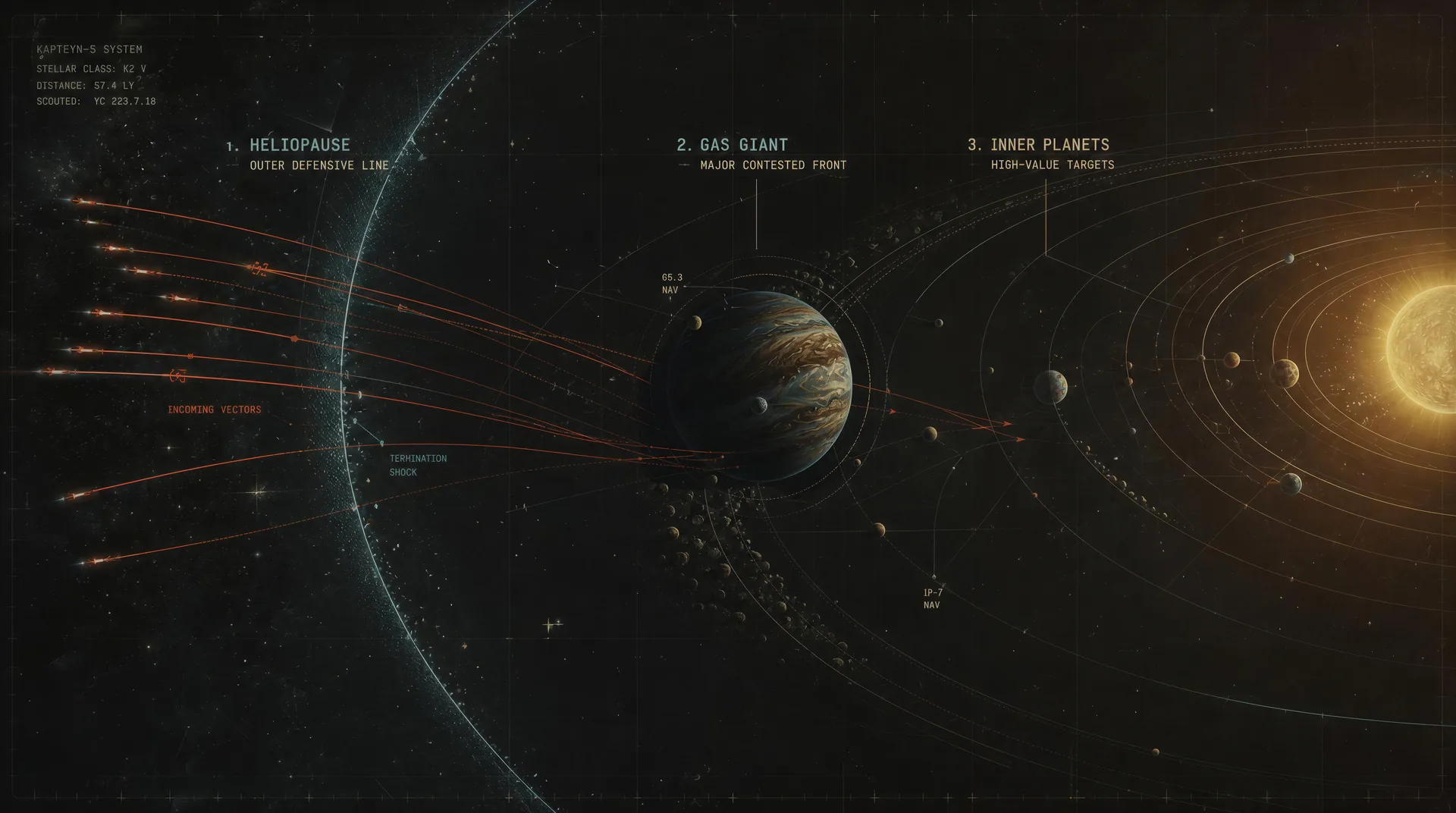
FIG. 2.7 — THREE FRONTS
Campaign / three fronts
Heliopause, gas giant, inner system. Industrial capacity and the last fight both matter. Lose the outer shell and the fleet can harvest; hold it and they burn ships for fuel.

Detect, intercept and delay the incoming fleet at the outer sensor shell before they can disperse into the system.
StakesLose the battle and the fleet can harvest water, metals and fusion fuel among the outer planets. Win it, and the invaders are forced to recycle their ships for fuel.

Fight over fuel, industry, moons and orbital infrastructure that provides a decisive advantage for the next battlefront.
StakesWhoever holds mid-system logistics can reinforce the outer shell or threaten the inner system core.

Defend or capture the populated core of the system.
StakesThis is where the war is won or lost. Each side faces the culmination of each battle in this final engagement.